
| Device | Hard drive |
|---|---|
| Manufacturer | Samsung |
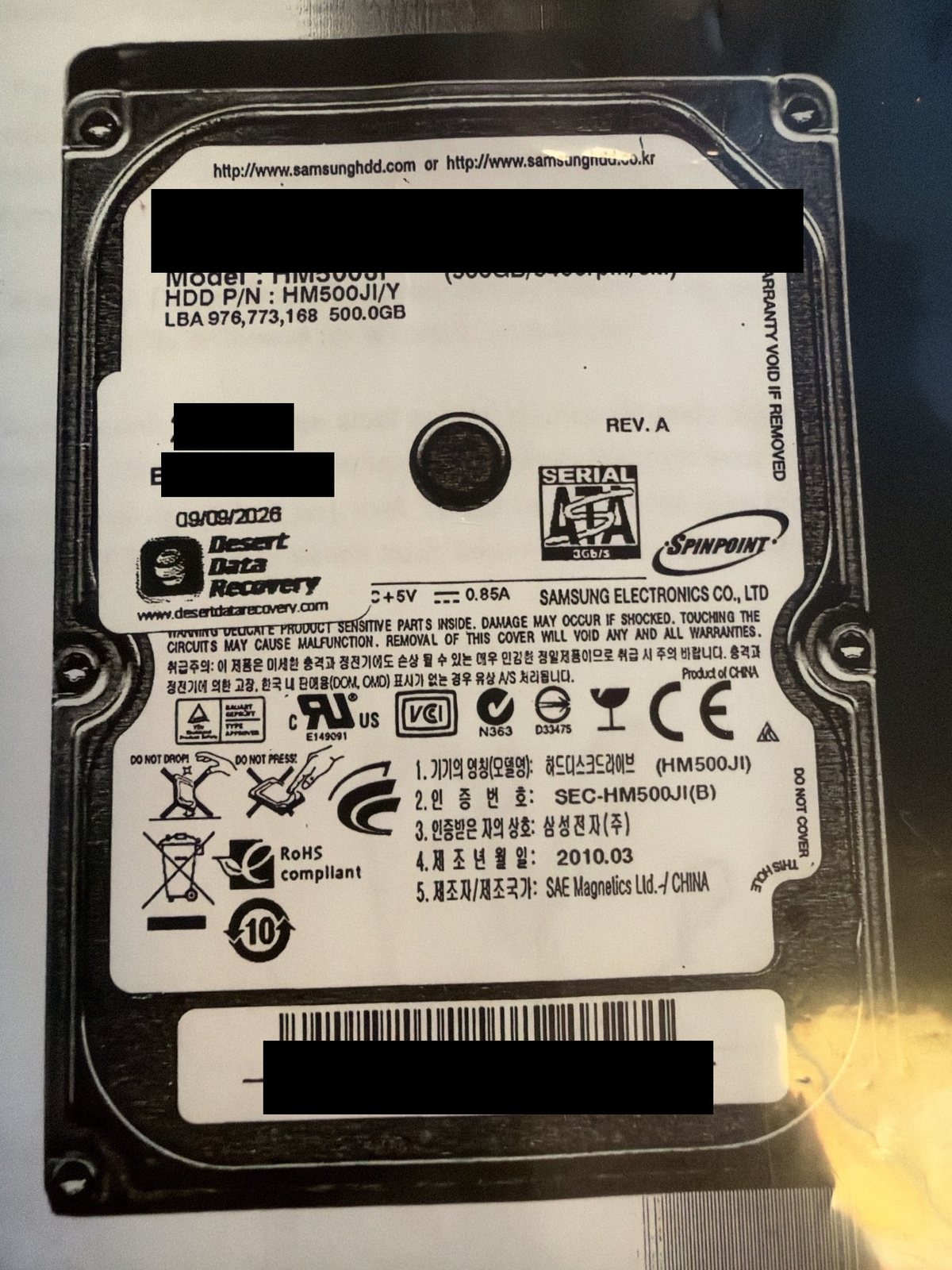
| Model | Spinpoint M7 HM500JI |
| Capacity | 500 GB |
| Interface | SATA (2.5-inch drive, pulled from a LaCie external) |
| Outcome | Full recovery |
Serial numbers and any customer-identifying details are deliberately omitted.
What came in
A 500 GB Samsung Spinpoint M7 (HM500JI) — a 2.5-inch drive that had been living inside a LaCie external, Mac-formatted as an HFS+ volume — that had died and stopped mounting. It came in completely dead: the controller would not initialise, so the drive did nothing when powered.
What we found
The drive's MCU (its main controller chip) had shorted, and the same failure had reached the preamplifier on the head stack. We confirmed the short was in the controller itself — not a neighbouring component — by moving it onto a known-good board, where it failed the same way. Two things made this harder than a routine board swap. On this drive family the ROM — the drive's own startup code and adaptive settings — lives inside the MCU, not on a separate chip, so with the controller shorted there was no practical way to read the original ROM back. And because the heads were damaged as well, a donor board on its own could never have brought the drive up.
What we did
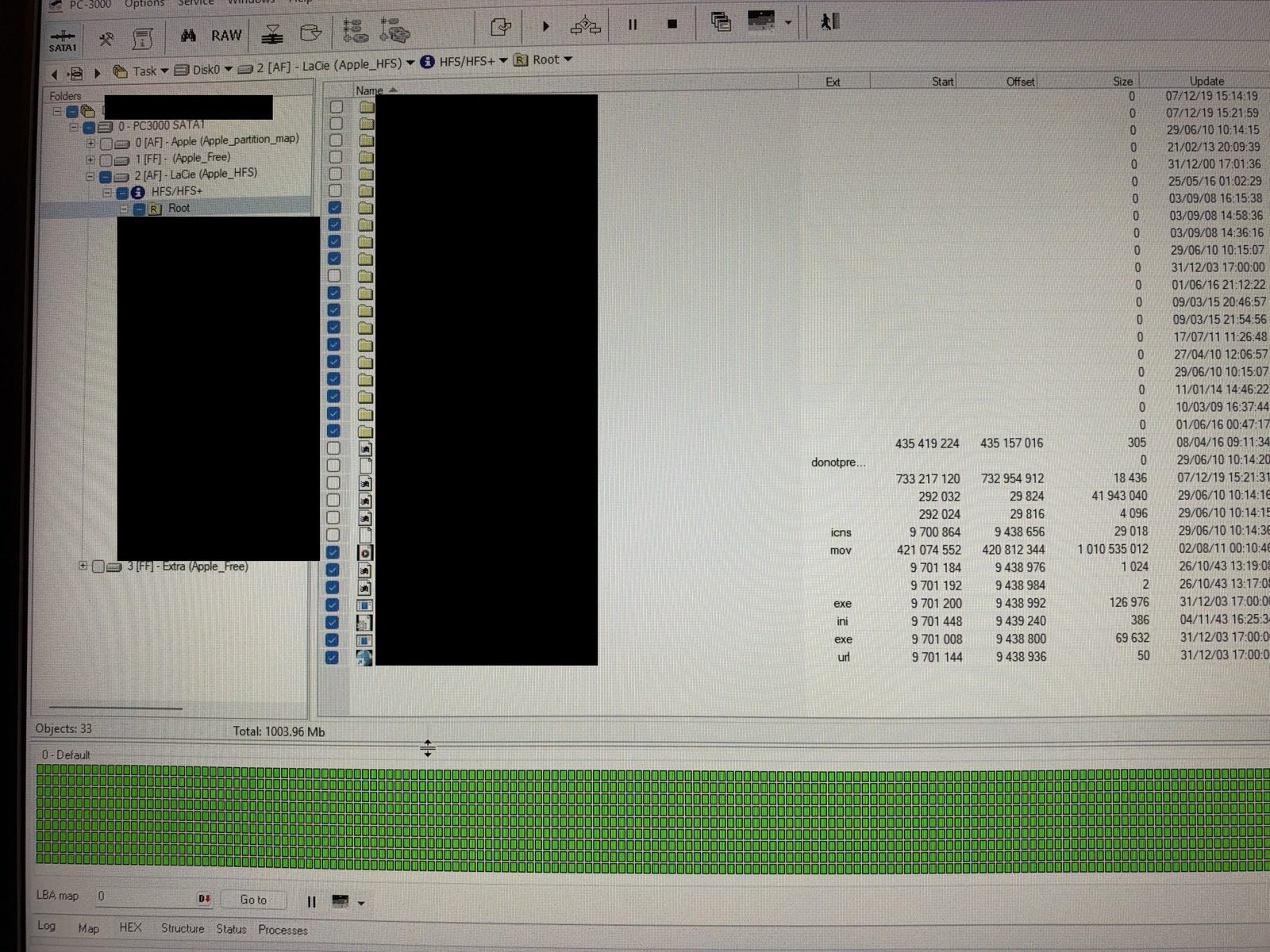
We fitted a donor board and replaced the damaged head stack in the cleanroom. The drive then spun up and read the start of its service area, but it never finished booting — on every attempt it loaded an overlay (code the firmware runs on top of the ROM) and halted. Comparing the patient's service-area modules against several M7 donors in our library, we found the cause: the donor board's ROM and the patient's overlays were from different firmware builds, and the patient's overlay was calling into a ROM address that did not line up in the donor's code, so the firmware faulted. There was no ROM backup on the platters to rebuild from. To get in, we hot-swapped from a healthy donor M7 — letting it boot fully on its own firmware, then moving the live board onto the patient — which gave clean access to the patient's service area so we could back up every module. The fix was to let the patient boot with overlays that matched the donor ROM: we wrote donor overlays (taken from a drive running the same ROM build as the board now on the patient) into the patient's service area, while keeping the patient's own translator, zone tables and defect lists. After cleaning up the defect lists and power-cycling, it booted with no halt, identified correctly, and gave full data access. From there we imaged conservatively — reading the file-system metadata and priority folders first, with the weakest head left for a final pass — and rebuilt the HFS+ volume to extract the client's data.
Outcome
Full recovery.
The lesson on this drive family is that a donor board's overlays have to match its ROM build — a matching drive label is not enough, because the label does not record the overlay build the firmware actually uses. And because the ROM is baked into the controller with no backup on the platters, a shorted MCU turns what looks like a "simple" board swap into firmware work, which is exactly why a recovery timeline can't be promised up front. It's the same firmware-first, image-second discipline behind our Toshiba translator-rebuild case. See our laptop, hard drive and external drive data recovery services.
Dealing with something similar? See our hard drive data recovery service, browse more cases in the case log, or read about what makes recovery hard.
Have a hard drive in similar shape? Start with a free evaluation — we'll tell you honestly what's possible with your device.
Request free evaluation →Free evaluation · No data, no fee · Talk directly with a technician.